the podium we almost didn’t believe in
It was over. The end of leg eight. The grand finale. Graham and I had gone from singing, hugging, and crying across the finish line earlier that day to sitting quietly on deck at anchor watch with the smell of popcorn drifting up from the galley, hot cocoa in hand. We could hear the sounds of vacation life on land, but we had one job: to make sure everything was “as it should be” while we sat at anchor. We’d just taken our compass bearings and completed the hourly log book entry. Now was our time to soak it all in.
Between sips of cocoa, Graham looked at me and said, “You know, I don’t think I’ve ever gotten first in anything.”
I was taken aback. A sixty-something white man, never gotten first? We laughed together, and then he went straight to defense mode: how rich he is in family relationships, how madly in love with his wife he still is, how much he genuinely loved his teaching career. But first place? Never.
It hit me. It wasn’t just him. Our team had gone twelve stages of this race without winning one. A couple of third places. A couple of charity awards. It always felt like we were pushing from behind. Then, finally, on our last chance, we came in first. It didn’t come early or easily, and it didn’t move our overall standing - we still finished eighth overall - but that only made it more beautiful.
We were not, by any measure, a team that looked destined for a podium. Our overall spot was long since locked in by the time we reached this last stage, no chance of moving up.
Race after race, the pattern repeated so reliably that we’d joke about it, in the dark way you joke about things that actually sting. A good start meant nothing. For a few days we’d sit in the lead pack, trading position with boats known for winning, and something in me would let myself believe this might be the one, while simultaneously being scared we might lose it. Then, almost without fail, the slide would begin. Just a slow bleed of places, day by day, often despite being the fastest boat in the fleet, until we looked up and found ourselves in the middle of the pack, or, a couple of times I don’t like to think about, dead last.
The times when we found our way to third place, I remember both finishes clearly: the relief of finally standing on a podium after so many legs of nothing. I remember, too, how quickly that relief curdled into something more like a ceiling. Third started to feel like the best we were capable of. Not a stepping stone. A verdict.
Underneath the results was a harder story, one that I’m careful with, because it belongs to more people than just me. We went through stretches that tested whether we were actually a team or just a bunch of amateur sailors pointed in the same direction. Trust broke in places and took a long time to mend. Leadership changed more than once, two first mates and three race skippers over eleven months, often with no warning. Each shift meant resetting our bearings and starting over again. We had, on paper, a team ethos, the kind you build in training weeks and repeat before a start line. But an ethos you’re performing and an identity you live out are not the same thing, and for a long time we were doing the former and calling it the latter.
Some crew came aboard already apprehensive, having heard the horror stories. Some arrived disillusioned, expecting a team and finding strangers instead. Some grew angry, feeling powerless to change anything. And some carried the weight of it all on their shoulders, wanting to fix things, unsure how hard they were allowed to push. I’ll let you guess which one I was.
What changed didn’t arrive all at once. It built out of the wreckage of the worst stretches, the way trust sometimes has to be rebuilt slower and more honestly the second time. We finally had clearly communicated expectations, backed by real accountability. A crew trusted to do better, and leadership invested in coaching them there. A team that understood the why behind our tactics, invested in making the most of whatever the weather handed us. We were a team over ego, living our identity instead of talking about why it wasn’t working. Focused on what each of us could do to help things run smoother, rather than on what felt unfair. And it worked.
This leg didn’t cross an ocean; rather, it provided the opportunity to hug the coast or go offshore to find the wind - that changed the math. Every shift in wind or current near land mattered faster and more, decisions that had to be right almost immediately. It also meant something we didn’t clock until after we’d crossed the line: there was no time to slip. On the ocean legs, our fade was slow, days of bleeding places one at a time. Here we wouldn’t get days. We’d get hours. There were days we questioned our own tactical calls, not knowing if they’d pay off until the next weather system rolled through. There were small packs of our fleet that gambled differently and looked, for a while, that they might take our lead.
There were gybes we mistimed, moments I thought, here we go again, this is just what happens to us. Despite all of it, the team kept showing up. We made more sail changes than ever before, and they were clean, which meant we broke less. When something did go wrong, we learned from it, as individuals and as a team.
We approached the finish line painfully slowly, caught in a wind shadow off the Isle of Wight. We’d put 40+ nautical miles between us and the next-closest yacht in the fleet. All crew were on deck. The emotions came in a flood, then the tears. The media rib came racing toward us, and the hugs started before we’d even crossed the official line. I looked around at my fellow worlders and felt proud of every one of us, for sticking it out, for thriving despite everything we’d been through. We’d come in first. For the first time ever.
We had to break as a team to rebuild. Do I wish we hadn’t needed those rougher stretches to get here? Of course. But in the end, they’re what made first place worth it. Not despite what it took. Because of it.
So there I sat on deck with Graham, two people from vastly different backgrounds who’d each waited a long time for a first place, bonded by what it took to earn one, sitting quietly with it before anyone else even knew.
As cliché as it sounds, we had to experience the valley to truly appreciate the peak. We had to crack to make room for that podium.
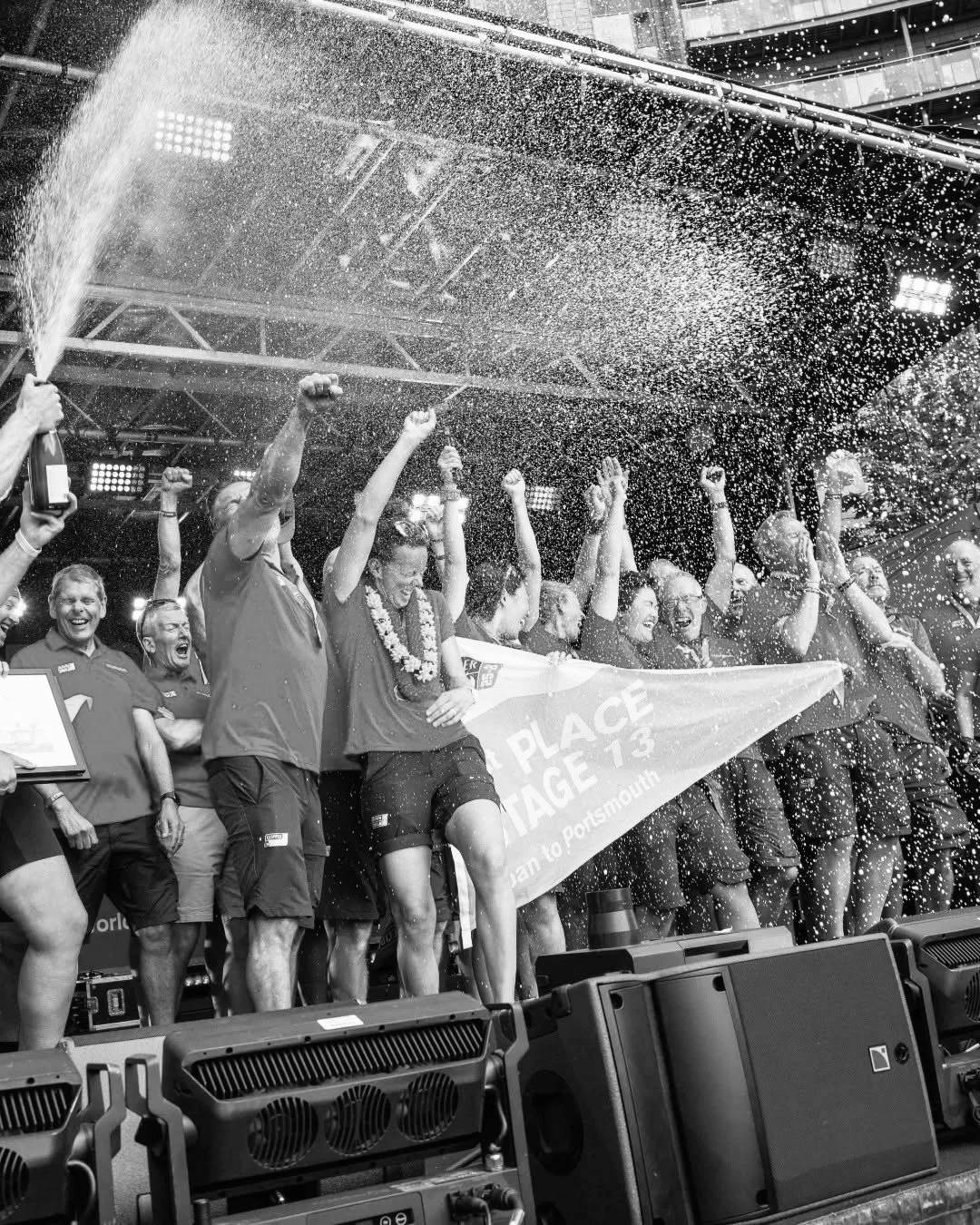
Clipper Round the World 2025-26 Team Qingdao celebrating their stage 13 first place win with a champagne spray on stage in Portsmouth, UK.
Author’s note: This post picks up right after the emotions of that finish line. If you haven't read about the moment we crossed it, you can find that here: the finish line i couldn’t imagine.